Wednesday, March 9, 2011

Shantiniketan


A few weeks ago I finally escaped from Kolkata to see some of the countryside. We went to Shantiniketan, which is best known for its university that was founded by famous Bengali poet and author of the Indian national anthem, Rabindranath Tagore.

After a 3.5 hour drive, we arrived and wandered through part of the university, where we found the building entirely made of stained glass above. It's supposed to be a gathering place for those of all religious and backgrounds. Even though it was deserted due to the university break (we went during the winter season), the colors and surrounding flowers were gorgeous.

There were still people walking around and shopping at the tourist stalls despite the school break. Many student groups and film makers were seeing the sites and snapping photos, taking in the museum and the peace that pervades the area around the university. There were no car horns, and you could hear the birds chirping in the trees.

Our last stop was in an NGO run village that sold goods made by local women's groups and meant to support them with living wages. We walked around the to back of the village where there were picnicking grounds. The final photo above was one of the scenes we saw.

After getting to see a little of the village, we had to head back to Kolkata, but I hope to make it out of the city again soon.

Sunday, March 6, 2011

Confluence of Cultures


At 8am a group of us met our guide, Ifte from Calcutta Walks, who took us on their walk called the "Confluence of Cultures". Over the next 3.5 hours, we went from a Buddhist Temple, the Anglo-Indian part of Kolkata, a Muslim Mosque, a Jain Temple, a Hindu Temple, and a Jewish Synagogue. The photos above were a couple of the sites and people I saw while wandering through the streets.

Kolkata is a city of many different peoples. We wandered through tight passages through local markets, saw Chinatown, spoke with a couple of curious Burmese tourists, and got to see parts of local neighborhoods that I've never seen before.

When we stopped at Armenian church, which dates back to the 1600s, a lady stopped to speak with the group. She said that at one point there were more than 10,000 Aremenian families in Kolkata, but now there are about 58 and Aremenians from outside the city and country are recruited to come to the school. Even with dwindling numbers, the community keeps the language and culture alive through the church and school they run.

Ending our walk at a small neighborhood mosque, we stopped to sit and rest for a minute, and a local man stopped to tell us a little about his religion. After a short exchange with the group, he came up to my friend and me and asked me how old I was, if I was married, and why not. There are some things that are the same anywhere here as those are the three most common questions I get in India. :)

Tuesday, March 1, 2011

The Airport or Mass Chaos


Touts and monks-- they stretched for miles when we showed up to the airport and tried to check into the flight from Bangkok to Kolkata. We stood in line patiently until the Jet Airlines folks finally arrived to start checking people in. We got to the counter, and were promptly told to go around to the other counter because they were only checking in people to Mumbai.

We shlepped our stuff around to the other side, only to be met with the sight above. Attempting the line that only had passengers with suitcases, we were told that they would only check in first class passengers. We stared at the touts and all the stuff, looked at the lady, and begged.

After getting to the gate, we were met with many, many Buddhist monks with strange looking bags. They were trying to figure out this security business and what was required of them before they got on the plane. This involved much discussion and searching of bags, right in the middle of the lane leading down to the entrance to the walkway to the plane. After we all got through and eventually figured out what was happening, the touts, in unison, looked at the "just passengers" and motioned us to the front of the line. Every single one of them had to gate check their bags because they had brought too many to place on board. *Sigh*

It was a relief when we got seated and on the plane. Just imagine what happened on the other end with baggage claim.

Saturday, February 26, 2011

Street Physics


Transportation on Indian streets defy physics. One example is the photo above. While dodging other cars, lorries, bicycles, pedestrians, and motorbikes (and the occasional human-drawn cart), these vehicles work their way down narrow streets where two lanes are made into four lane roads. One taxi driver recently told me that "God gave us two tools to survive on the streets of India, a loud horn and good brakes." Honking is used to indicate everything from anger, notifying someone that you want to get by, flirting with another cute driver, and general thrill that you were able to get to the other road.

On a trip outside of Kolkata, I truly learned what signals drivers send one another. Our driver, on the return trip after dark, only turned on his lights when approaching semi trucks and laid on the horn to indicate the truck should move over. Until the semi moved over, the horn continued to go. One semi refused to move and our driver tried to pass on the shoulder-- until the shoulder disappeared and we were suddenly off roading. We got back in one piece, however. A colleague suggested that in the future we should offer a tip in 10 rupee notes and tell the driver that each time he scares his passengers, one ten rupee note is removed. Then remove one immediately to show him you're serious. I chose the second method of fall asleep during the trip and pray I don't die. I think I'll try the former on the next trip :).

Either way, make sure you have a loud horn, good brakes, and a lot of luck and you'll be fine on the roads.

Tuesday, October 26, 2010

Belated Durga Puja Part 2


A friend was kind enough to invite me and another American to his community in Salt Lake to see the last day of Durga Puja, Doishumi, from a more local perspective. It was incredible. Dressed in sari, my friend and I arrived around 5pm, hung around, and then watched as drumming and dancing started and we were pulled into the crowd to dance and get our faces painted with the red shindur. After three or four hours of the drumming and dancing, we watched as the community said good-bye to their Durga and loaded it up to go to the immersion ceremony. Another friend drove us to the river, and we watched as each community carried their idol to the river, turned it around (can't remember how many times) and then immersed it into the sacred Ganga River, saying good-bye until next year.

Thursday, October 14, 2010

Puja Part 1


A friend of mine and I finally got out to see some of the pandals, which house the idols of the Goddess, Durga, during the largest Hindu celebration in West Bengal. Imagine Christmas light contests in various neighborhoods and then make it more competitive. Communities spend thousands, sometimes millions of dollars constructing the "house" and its surrounding decorations, then even more for the idol of the Goddess. We went to Alipur and New Alipur in southeastern Kolkata to see some of the idols. These are just three photos that give you a taste of what we saw and some of the diversity amongst the idols and pandals. Each pandal has a different theme. The themes we saw included astrological signs, a pandal made completely of soda bottles, and one based on a village area. Tonight another friend is taking us to see some of the pandals after dark. Should be exciting! Happy Puja!

Thursday, October 7, 2010

Kumarthulli


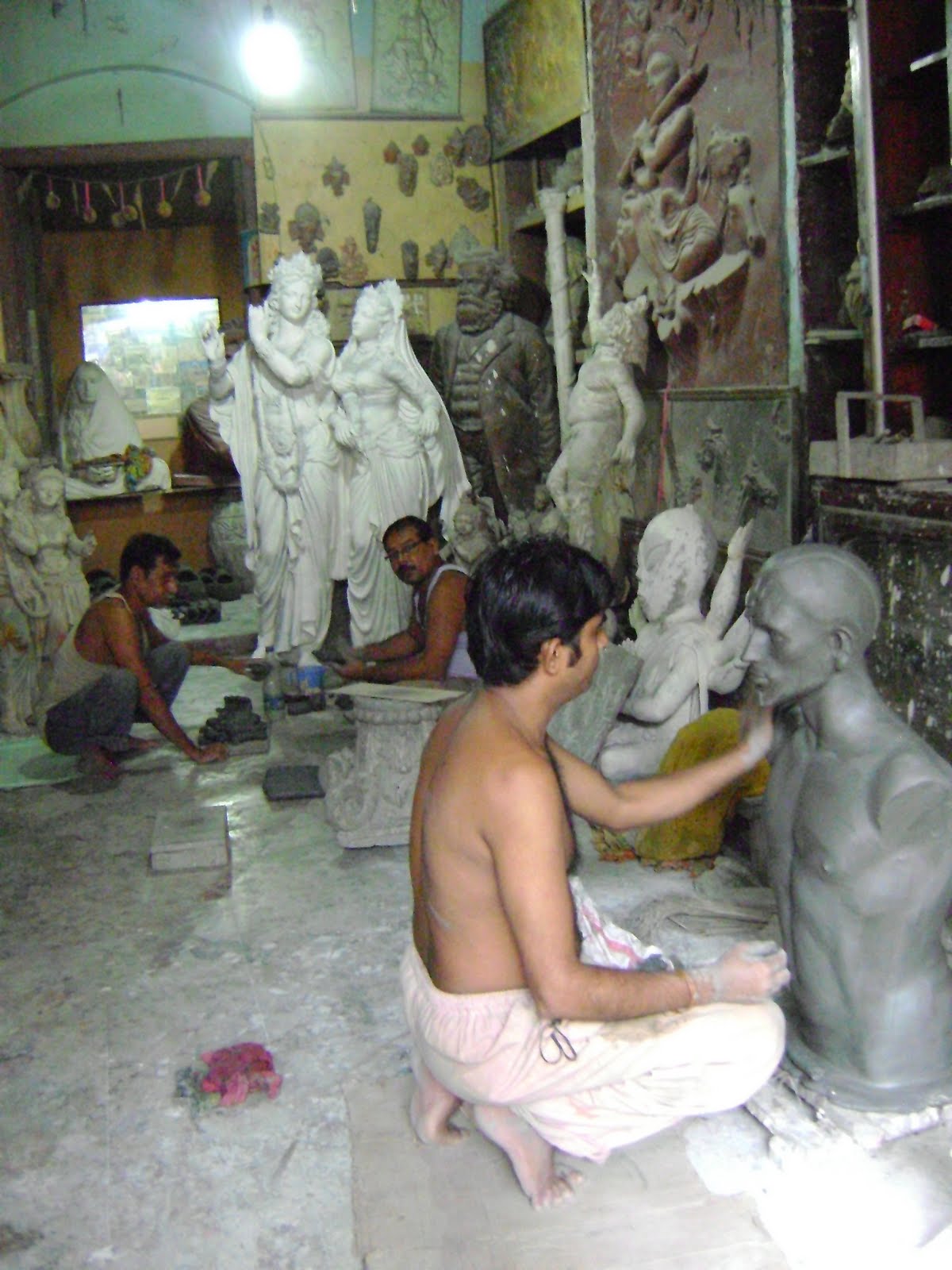
One Saturday I went to Kumarthulli, where the locals do master craftsmanship for the religious idols for the various Hindu and other celebrations . These are some of the photos of these master artisans who work in the smallest little shops. This was a couple of weeks before Durga Puja, the biggest Hindu celebration in West Bengal. Durga Purja lasts for ten days, with various communities setting up pandals, which are structures that house the goddess. Durga is very big in Kolkata and has ten arms. She is known as the universal mother. Kumarthulli is in one of the oldest sections of Northern Kolkata. Very, very cool to see and made me even more excited for Puja time, when all the statues are fully decorated and placed throughout the city at the different community structures.